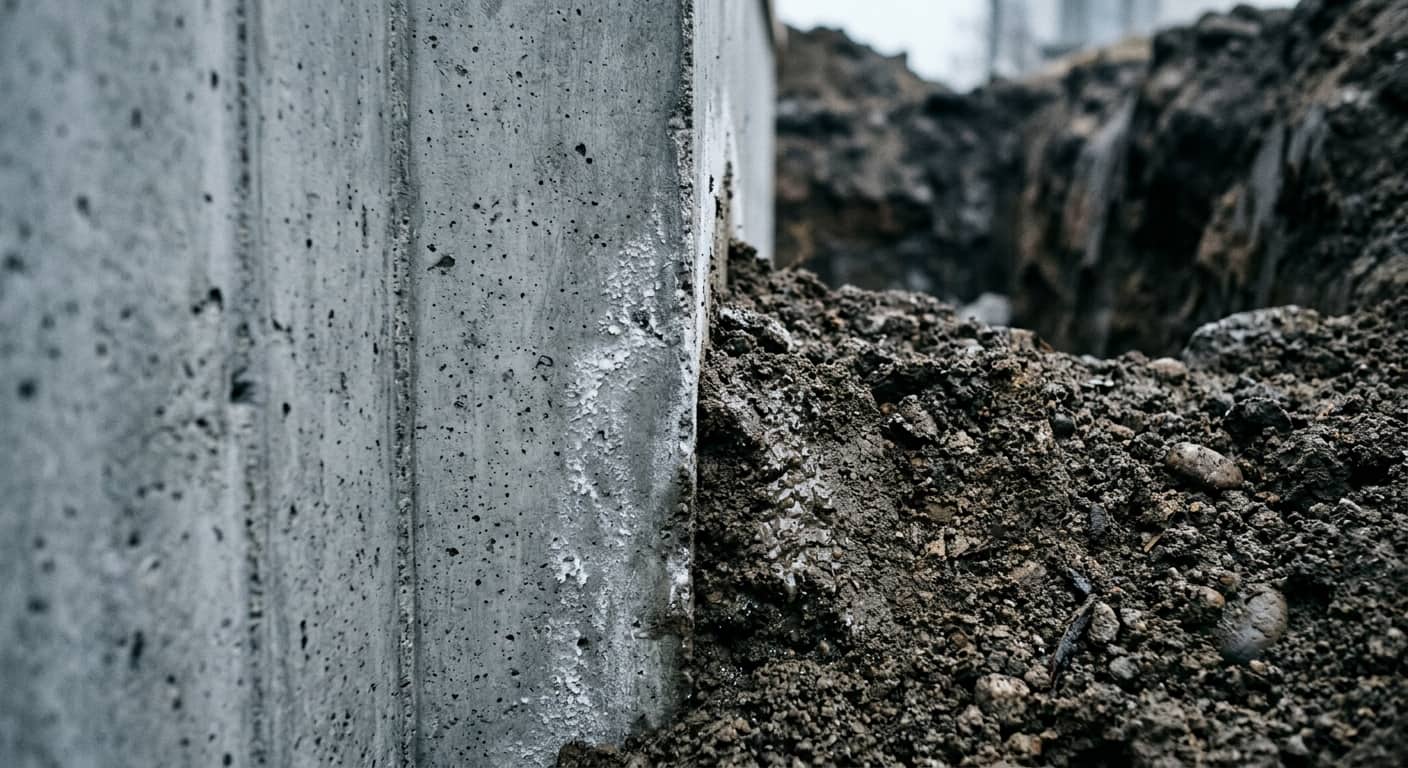
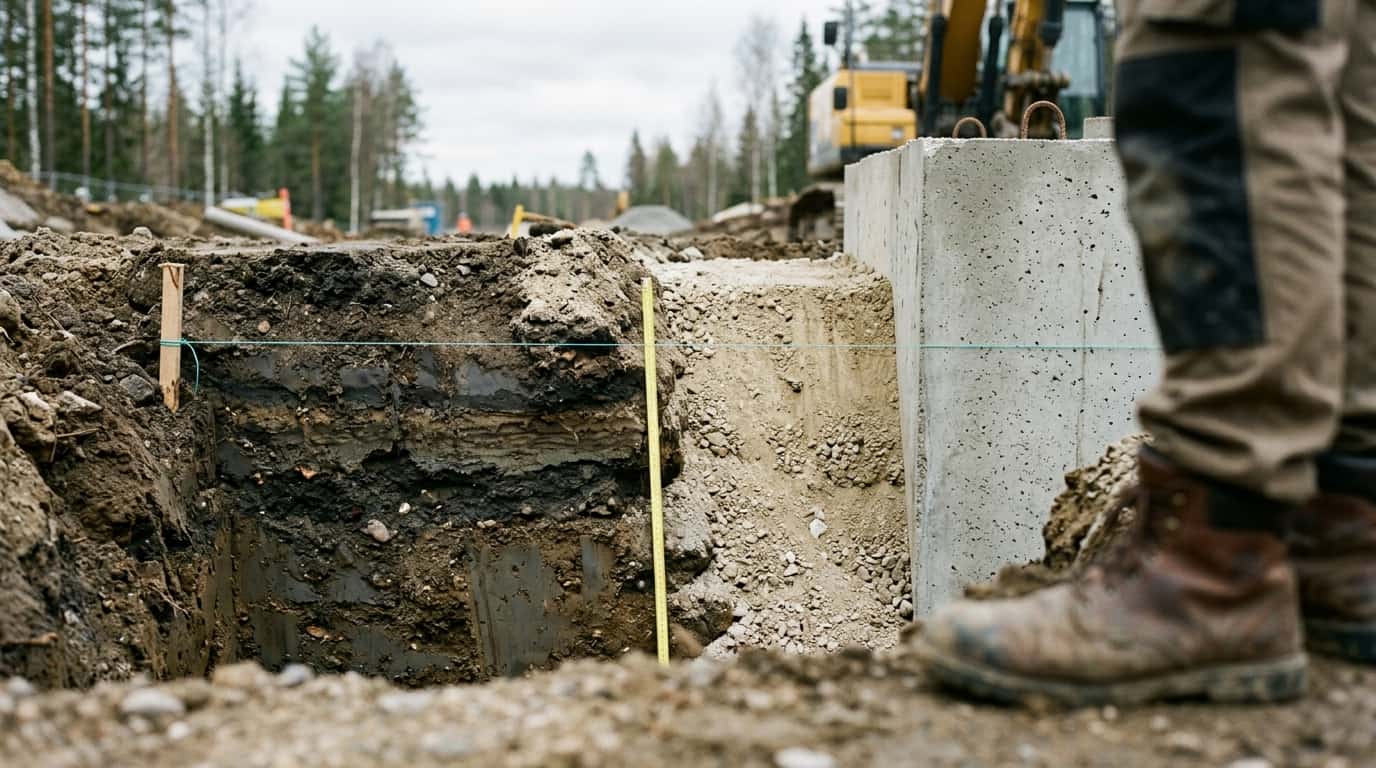
Buried infrastructure concrete in Finland often sits in chloride-bearing or salt-loaded ground for decades. Ions do not only enter through the concrete surface: ordinary backfill in the contact zone can carry the same aggressive load. SubLay C Form 1 is aimed at that envelope, without changing the mix design or reopening structural approvals.
Engineering proposal only. Observations discussed here are not SubLay test results or approved performance claims.
Two mechanisms frequently discussed in reinforced-concrete durability are chloride exposure and carbonation. Chlorides can initiate reinforcement corrosion even when the concrete remains alkaline. Finnish technical guidance highlights adequate concrete cover, dense concrete, and crack control as important protective measures. [1] Epoxy, membranes, mix inhibitors, and specialty rebar address other parts of the system; this note focuses on ions that can travel through soil and backfill in the contact zone. On the coast, acid sulfate soils add a separate ground-chemistry risk once deposits are disturbed.
A single universal chloride threshold is a poor basis for a new product claim. RILEM TC 235-CTC investigated a test method for the chloride concentration associated with corrosion initiation, but its interlaboratory exercise did not achieve the intended reliable recommendation. This illustrates the importance of specimen conditions and measurement uncertainty. [2]
Carbonation presents a different issue: it changes the chemical environment around the steel. A RILEM review found that carbonated concrete does not invariably develop substantial corrosion damage. Moisture conditions and the properties of the concrete remain important. Carbonation depth alone therefore cannot describe the complete corrosion risk. [3]
For SubLay, the practical implication is to keep the claimed mechanism measurable. If the intended benefit is reduced chloride exposure, compare chloride profiles and corrosion-related observations in matched systems. If chemical buffering is proposed, examine that hypothesis separately. A change in the pH of the surrounding bedding should not be presented as proof that the embedded steel is protected. The bedding, concrete cover, and reinforcement occupy different positions in the system, and the proposed link between them needs experimental evidence.
Engineering example and application
For example, a lower chloride content at the outside of a bedding layer and a lower chloride content at reinforcement depth are different observations. The first describes a boundary condition; the second is closer to the proposed protection mechanism. Similarly, a change in one electrochemical reading should be considered with the rest of the evidence. A practical report should state what was measured, at which position, and under which moisture condition. This prevents an intermediate indicator from being presented as a complete service-life result.
Selecting indicators that match the protection claim
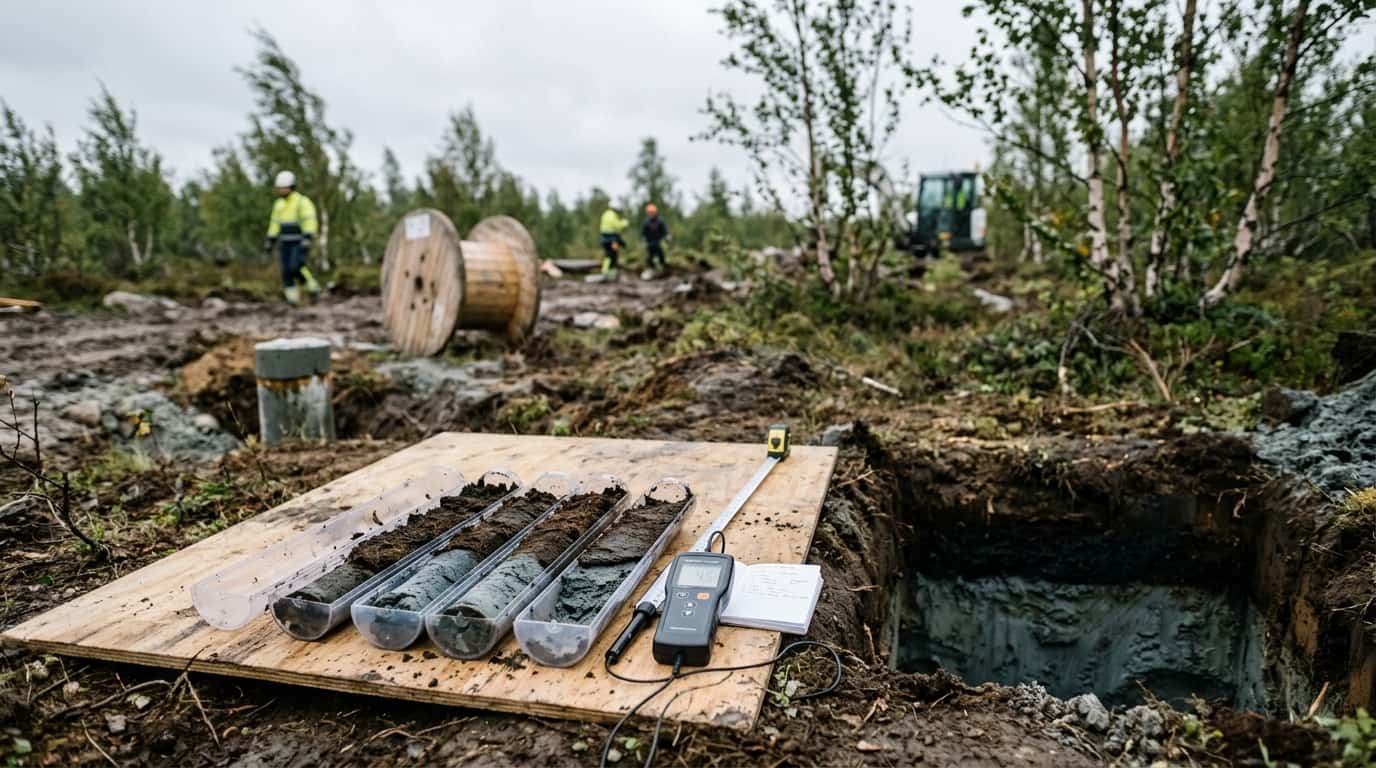
For a proposed corrosion study, keep the concrete mixture, cover, curing, and reinforcement preparation comparable across groups. Otherwise, a difference attributed to the bedding may originate in the concrete specimens. The study should also explain its criterion for corrosion initiation and how uncertainty will be reported. This is particularly important when comparing a new surrounding material with an established backfill.
The matrix distinguishes observations from the conclusions they might support. It is an interpretation aid, not a catalogue of mandatory tests. A laboratory should choose the actual methods and specimen arrangement for the research question. Where a test gives indirect information, that limitation should remain visible in the report.
Table 2: Proposed review framework
| Observation | What it addresses | Limit |
|---|
| Chloride profile | Ion distribution with depth | Not steel loss itself |
| Carbonation depth | Extent of the affected zone | Not the corrosion rate |
| Electrochemical data | Corrosion-related response | Method and moisture matter |
| Steel condition | Observed corrosion damage | Exposure and duration matter |
| Bedding chemistry | Surrounding conditions | Not the concrete pore solution |
Original engineering review matrix; it does not prescribe acceptance limits or legal requirements.
For SubLay, a useful first claim would be narrow enough to falsify: a stated change in a relevant indicator under one defined exposure. If that change is absent, the formulation or hypothesis can be revised. If it is present, additional work is still needed to connect the observation with long-term corrosion behaviour and the conditions of a real installation.
That is the same discipline we use on the product side: status labels instead of headline protection percentages. See How we publish validation status.
Sources
[1] Finnsementti, Finland. Betonin rasitusluokat lyhyesti [Concrete exposure classes in brief]. Technical guidance, undated.
[2] Tang L. et al. Experiences from RILEM TC 235-CTC in recommending a test method for chloride threshold values in concrete. RILEM Technical Letters 3 (2018), 25–31. DOI 10.21809/rilemtechlett.2018.55.
[3] Angst U. et al. Corrosion of steel in carbonated concrete: mechanisms, practical experience, and research priorities – a critical review by RILEM TC 281-CCC. RILEM Technical Letters 5 (2020), 85–100. DOI 10.21809/rilemtechlett.2020.127.

Discussion
Comments
Ask about placement, pilots, or product framing. Comments are public; we may reply from the SubLay team.
No comments yet. Be the first to start the thread.